Selling a parent's Farmingdale house after a move into assisted living
Nobody has died. That is what makes this different from an estate, and it is why families sit with a parent's empty house far longer than they ever intended to.
We are not going to push. Arranging a nursing home place is exhausting, the siblings may not agree yet, and your parent may have feelings about the house that deserve room. Take the number, take your time, and call when the family is ready rather than when a buyer wants you to be. Selling a parent's house after a move into assisted living is not a decision that improves under pressure.
Get the nursing home benefits question answered before you sell
There is a sequence here that saves families a great deal of money, and almost nobody knows it going in. Before a parent's house is sold, find out how the proceeds interact with whatever is funding the assisted living or nursing home.
An elder law attorney handles that in a single meeting. We raise it on every one of these calls, because the families who did it in the other order are the ones who wish they had not. Ask before the house goes under contract, not after. The question is simply how a sale interacts with the benefits funding your parent's assisted living.
What this looks like in Farmingdale specifically
Farmingdale is roughly 8,466 people in Nassau County, ZIP 11735, and the housing stock is mostly cape cod, colonial, ranch. Around Main Street and Conklin Street, most of it is old enough that the mechanicals are on their second or third life. The Farmingdale stop pulls buyers who commute, which supports the good houses and does very little for the ones that need a roof. We have been buying across Nassau County for 15+ years. We know what the Farmingdale Union Free School District does to a resale price, which blocks still have oil tanks in the ground, and what a house like yours is actually worth here.
The median is up 5.5% year over year as of 2026-10. A firming market gives you a little room for error on price, which is worth more than it sounds when the house is not in showable condition. A $759,611 median puts Farmingdale in the band where buyers are stretching to afford the house and have nothing left for the roof. That is precisely the buyer who walks away from a property needing work, and it is why condition matters more here than the price alone suggests. The median house here goes under contract in about 25 days, which is quick for Long Island. It is also a figure that only applies to property in showable condition.
Why the belongings stop families selling
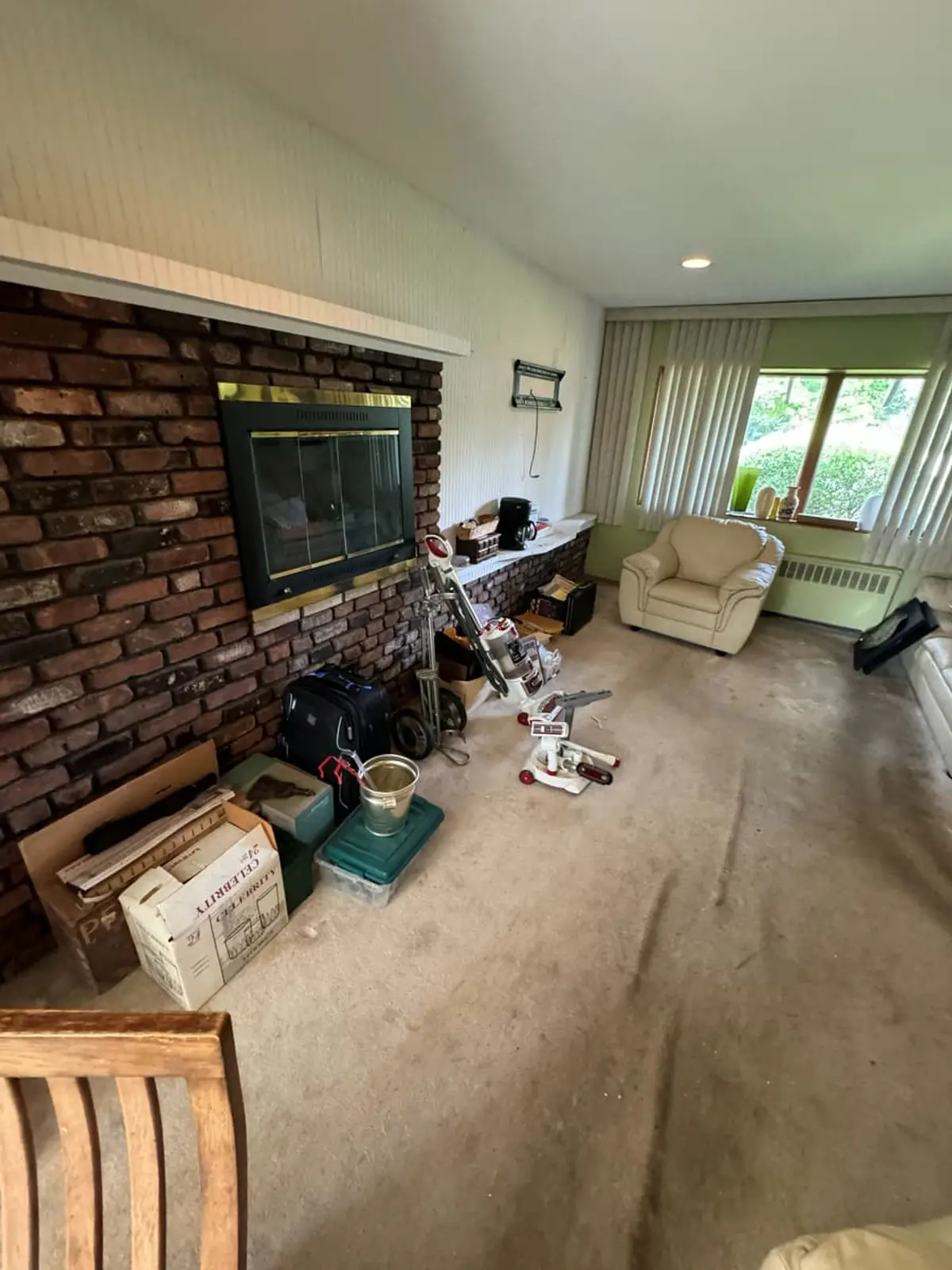
The house is full of a parent's life and somebody has to decide what happens to all of it. Siblings disagree, nobody wants to throw anything away, and the boxes stay where they are for another year.
We buy the house contents and all. Cupboards full, attic untouched, basement as it stands. Take the photographs, the paperwork and whatever your parent asks for, and leave the rest to us. The state of the house does not move our number the way families fear it will. We buy parents' houses after a move into a nursing home in whatever condition the move left them.
Carrying costs against nursing home costs
Taxes, insurance at the vacant rate, heat through the winter, and somebody driving past to check on it. In Farmingdale that adds up quickly, and it adds up against assisted living costs that are already substantial.
That is not a reason to rush. It is a reason to know the figure. A family paying for a parent's nursing home out of savings should at least see what the empty house takes out of the same pot every month. Two costs, one pot, and the assisted living bill is the one that will not wait. The median house in Farmingdale sold for $759,611 and took about 25 days to go under contract, then another 45 to 60 days waiting on the buyer's mortgage. That is 70 to 85 days in total, for a house that was ready to show on day one.
How we arrive at a number on a parent's house after a move into assisted living
For a parent's house after a move into assisted living, the starting point is the price once it is fully repaired. We subtract what the repairs cost and then a margin for being wrong about the price or the repairs. No algorithm and no trade secret: that is how the number is built.
- What it is worth repaired. Not the Farmingdale median of $759,611 on its own, but what houses like yours on your street actually closed at recently.
- What the work costs. Roof, boiler, electric, the kitchen and bath. In Farmingdale the stock is largely cape cod and colonial, and on houses that age the mechanicals are usually the expensive part rather than the cosmetics.
- How long we will hold it. The median Farmingdale house goes under contract in about 25 days once it is showable, then waits 45 to 60 days more on the buyer's lender. Ours has to get to showable first, and we carry taxes and insurance across the whole of it.
- What we are wrong about. Every renovation turns up something nobody could see on the walk-through. We build that risk into the price, and it explains a good part of why cash offers come in below retail.
Where our margin actually comes from
Plainly, because buyers are often vague here: we run millions of dollars of construction a year. At that volume we pay contractor prices for materials and keep steady crews working twelve months a year, so a given renovation costs us roughly half of what a homeowner pays for the same job.
That is where our margin is. It is also why fixing the house up yourself first rarely pays off. You would be paying retail for the work and counting on the sale price to cover it, and it usually does not. We earn our money on the construction side, not on the price we pay you.
If the figure does not work, say so; we would rather know than try to talk you round. We will look at what is going on and tell you honestly which options make sense, including the ones without us. Listing with an agent is the better route for plenty of sellers, and we will tell you if it is yours.
What we actually do when a parent moves into a nursing home
We have worked with a great many families after a parent moved into a nursing home, and the pattern repeats. Nobody is sure who is allowed to sign, the contents feel impossible, and everybody is too tired to start.
We are useful on all three. We can tell you what documentation a closing will need, take the house with everything still in it, and work to whatever date the family picks. When a question belongs with an elder law attorney or a CPA, we have people we call on and we will make the introduction. Long-term care planning and house sales run on different tracks and both need somebody watching them.
Ask a CPA before you sell a parent’s house
Tax treatment is a CPA's profession and this is the situation where that call matters most. Selling a parent's house now and inheriting it later sit on different footing.
On a Farmingdale house bought decades ago and held through every boom since, the difference can be large enough to outweigh everything else the family is weighing, including the monthly nursing home bill. Ask the CPA specifically about basis. Then come back to the question of who buys the house and when.
How selling a parent's house after a move into assisted living in Farmingdale works
- 1
You give us the address
The street address in 11735 and a sentence or two about the condition, by phone or the form. No photos needed, and nothing has to be cleaned or repaired first.
- 2
We come and look at it
One visit, one person, usually under half an hour. On a cape cod or colonial of the age most of Farmingdale was built, we are mainly looking at the roof, the boiler and the electric rather than the kitchen.
- 3
You see the number
Within a day you get our offer as one written figure. Get a Nassau County agent's opinion alongside it if that helps. For a house that could go on the market as it stands, listing may come out ahead, and we will tell you if so.
- 4
Closing happens on your date
If you need it done quickly, it can be. If probate, a tenant or a move means waiting, we wait. What you skip is the 70 to 85 days a Farmingdale listing usually spends on finding a buyer and then on that buyer's lender.
If the Farmingdale house is what pays for the nursing home
Then the timing question is not sentimental, it is arithmetic. Assisted living costs run monthly and are largely fixed. A parent's house produces one number, once.
What matters is knowing how many months of assisted living or nursing home care the proceeds actually cover, and that depends on a real figure rather than an estimate drawn from a neighbor's sale. We will put one in writing at no cost and with no expectation, precisely so the family can do that math properly. The median house in Farmingdale sold for $759,611 and took about 25 days to go under contract, then another 45 to 60 days waiting on the buyer's mortgage. That is 70 to 85 days in total, for a house that was ready to show on day one.
Common questions
Can we sell a parent's house to pay for assisted living?
Usually yes, and it is one of the most common reasons families sell. The two things to settle first are who has authority to sign, which is a power of attorney or guardianship question, and how the proceeds interact with any benefits funding the care. Both belong with an elder law attorney and both are quick to answer. Once they are settled, the sale itself is ordinary.
Can my parent still sell their Farmingdale house if they have dementia?
That depends on capacity and on whether a power of attorney is already in place. It is a legal question and an important one, so speak to an elder law attorney before anything else happens.
We are not ready yet. Is that a problem?
Not at all, and it is the normal answer. Families take months over this while a parent settles into care. The number gets refreshed whenever you come back.
Do we have to clear the Farmingdale house before selling?
Never for us. Full attic, full basement, furniture still in place, all of it is fine. The cleanout is the part most families dread, and handing it over is usually the biggest relief in the whole process.
What if my siblings do not agree yet?
That is extremely common and it is not our business to referee it. A written number often helps, because families argue less once everyone is looking at the same figure instead of their own guess.
Will selling affect the benefits paying for my parent's nursing home care?
It can, and this is the question to answer before you sell rather than after. An elder law attorney will cover it in one meeting, and we tell every family the same thing regardless of whether we end up buying.